La Colors Color Last in Grudge Color Reviews
An exploration of what director Damien Chazelle is proverb with the chief colors of his quintessential Hollywood honey story.
By · Published on Feb 22nd, 2017
Call me a sucker, but I didn't know where La La Land was going to land. The story is a quintessential 1 most making it every bit an artist in Los Angeles, and the things we sacrifice along the way. Mia, a struggling actress, collides with Sebastian, a struggling musician. It's heartfelt and earnest, specific and sweeping, merely information technology's never clear cut – even equally it conspicuously telegraphs the inner lives of its artists.
See, details matter in La La Land. The fact that Mia changes out of heels to matching tap shoes when Sebastian and her have their twilight dance is important; we won't see her in heels again until she's left Sebastian. That Sebastian drives a classic, brown Riviera distinguishes him from Mia's sensible, modern Prius.
Likewise, the color pallette of a scene matters. Manager and author Damien Chazelle's bright, detergent-commercial colors are (like many mechanics of the flick) an homage to big Hollywood musicals of sometime. But the primary color choices he makes also conveys much more about the pair of artists, and the lives they cull to lead.

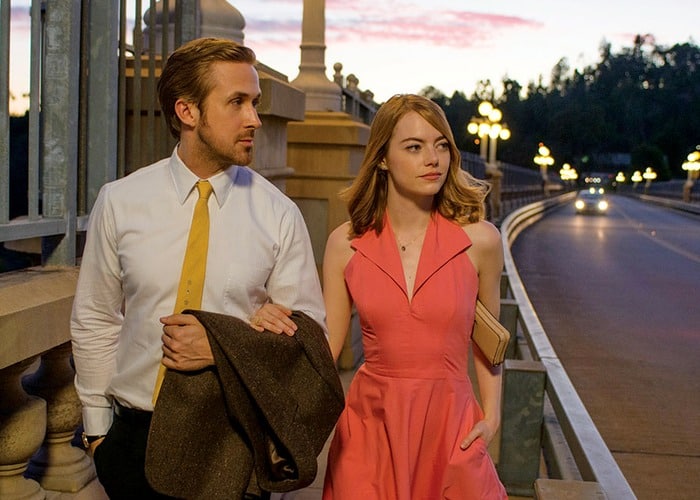
Blue is often the tinge of the (successful) Hollywood that is always surrounding Mia and Sebastian. Everything from Ingrid Bergman to murals of classic flick stars to The Van Beek club are tinted with information technology. These are the people who made it, who steered their career in some manner Sebastian and Mia have non when nosotros first come across them.
In the world of La La Country blue represents inventiveness and control. It's the color of the adapt Sebastian pulls out when he's playing gigs; the mood lighting in the Lighthouse Cafe when Sebastian first meets Mia after work; and of class, it'southward the colour of Mia'southward dress when she goes to the ill-fated party with her roommates.
That party scene foreshadows Mia's artistic potential early on. Unlike her partner, Mia isn't quite distinctive right off the bat; up until then the movie has painted her as just another hopeful starlet. And while Sebastian gets a few scenes that demonstrate his skills as a pianist, Mia's talent is a bit more obscure. Some of that is merely part of the nature of a musical; it'south a lot easier to showcase someone's instrumental expertise than it is someone's acting talent inside a film.
But it also leaves a bit of wonder for that final audition scene, when Mia has everything on the line. It's the fullest we hear Emma Stone'southward singing voice go, and it's (eventually) clear that the casting directors saw what she believed she had all forth.
Past the end of the picture show the world sees Mia as the sort of talent she ever dreamt she could exist, but information technology's that get-go party scene where she first distinguishes herself in a vivid blue dress. Unlike her roommates, who (though vivid in their ain right) are color-blocked similarly to other folks at the party, Mia's clothes stands out from the crowd.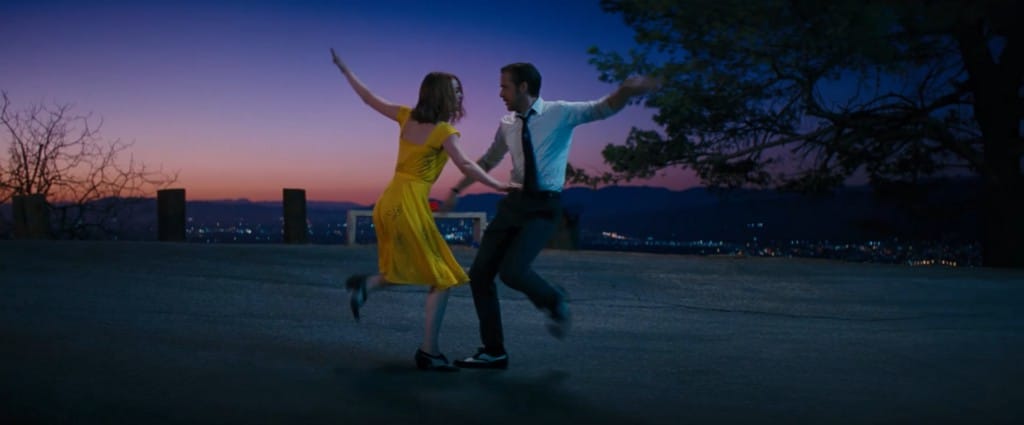
When you see xanthous in La La Land it normally means there's change ahead. Despite existence i of the first colors we see in the technicolor trip the light fantastic sequence that opens the movie, it's non a color we meet very often in the first function of the movie – why would it be? We're only beingness shown Sebastian and Mia's lives to-date; the establishing of the status quo. And and then yellow appears mostly in spurts.
Until its about prominent entrance, Mia'southward dress at the third meet-cute. This is the pool party where she and Sebastian finally talk, flirt, and dance. By the finish of the night, as Sebastian returns to the car his feelings take certainly evolved.
Perhaps the person we see the color most associated with is Keith. His introduction comes halfway through the motion-picture show equally someone who could modify things for Sebastian who has been struggling to find the kind of jazz work he wants to practise, and he immediately stands out from the palette we've seen and so far. His turtleneck is a deep mustard color which (although bold similar the colors throughout La La State) hasn't been seen much upward to now.
Keith ultimately represents a reordering to Seb's life in ii major means: A steady gig playing piano, and his jazz-fusion ring, a far cry from Sebastian's "pure" jazz philosophy.
The motion picture uses the colour palette to draw a schism betwixt Keith and Sebastian's styles from their very beginning rehearsal scene. Sebastian shows up, decked in his trusty blue adapt, ready to work. Equally the pop-inclinations of Keith's combo become clear, the neutral and blue tones of the room are suddenly overwhelmed by the red of Keith'south guitar and the yellowish of the other musical instrument cases.
Nosotros larn that Sebastian has a bad history with Keith, after being passed over for a band dorsum in the day. Keith shares at the end of the jam session that, while Sebastian was the superior central player, his disability to compromise his command of his art and modify himself for an ensemble was what moved the dial in the other direction. But the colour-shift has already choreographed that shift for the audience.
Likewise, Sebastian starts The Messengers gig bathed in solo and bathed in bluish lite. But once the synth and the rest of the philharmonic kicks in, the phase (and Mia'due south face in the audience) are swathed in bright, warm yellows.
Those sort of yellow lights don't appear all that frequently. The next time we see them is when Sebastian drives to Boulder City to bring Mia back for the big climactic audition.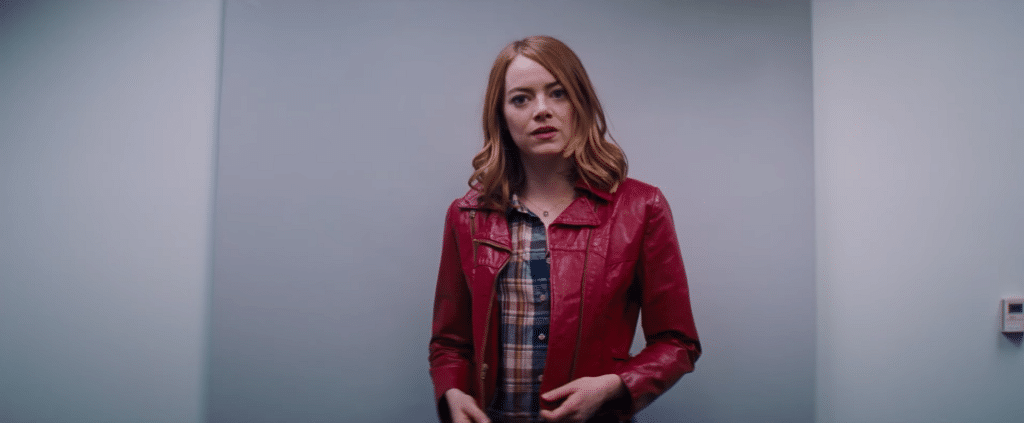
The elusive truth of the motion picture's palette. In La La Land, red is used as a manifestation of reality; a way to either wake characters up to the truth they're living, or dangle the promise of something greater to a higher place them.
When we first come across Mia at her coffeeshop chore everyone stops to sentinel a famous actress who Mia immediately recognizes and envies, wearing a brilliant ruby dress. And when Sebastian is forced to find a fashion to brand ends run into at the pool party, he and his keytar are in burn down engine-red. Similarly it'due south the colour of the stool when he signs his contract with Keith, a compromise of his artistic sensibilities. Red neon lights blaze beyond LA, and are the colour of the neon bars that frame Mia equally she stops after hearing Sebastian play for the first time. Equally the print of Rebel Without a Crusade melts away and interrupts what would be their first kiss, the hitting red of the Rialto's seats backdrops their sheepishness.
Perhaps the nearly interesting fashion Chazelle builds up reality'due south power through ruddy is by mixing it with other colors. Our master characters discover themselves in rooms and streets bathed in warring blue and scarlet lights, similar when when Mia and Sebastian discuss her show's first draft and his club's proper name. Though the creativity and authenticity of cherry-red and blueish mix to make purple, a personification of love (meet the first rendition of "Urban center of Stars," or the stunning waltz in through the galaxy), Chazelle all too often doesn't let the colors mix. Their wearing apparel, their calorie-free, their neon – it rarely finds a place to comingle.
Though Mia and Sebastian's lives grow increasingly intertwined, in that location's always something holding them back from a seamless meld. They can't return to the promise and passion of that showtime purple trip the light fantastic in the stars. That is, until the the "Epilogue."

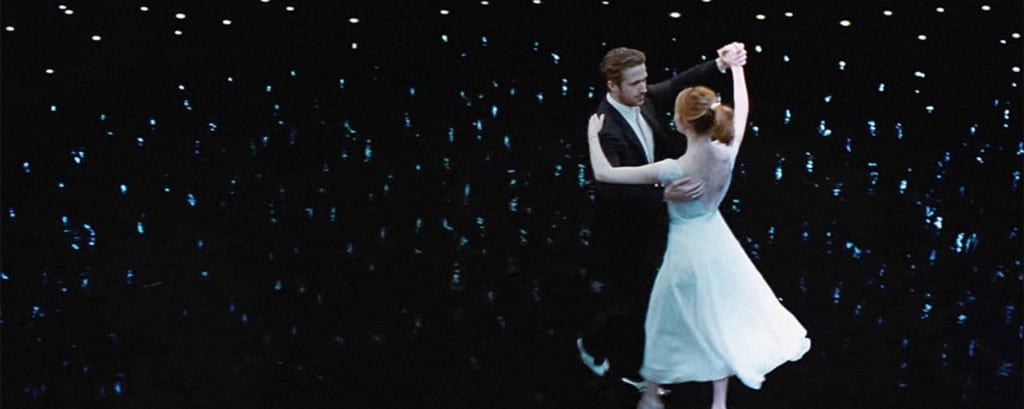
One time Chazelle's gear up the phase with his building blocks of color, he's constantly playing with how they interact: The aforementioned purple, or the mix of xanthous'south change and blue's control to yield the dubiousness of green (see the second rendition of "Urban center of Stars" as Sebastian mulls selling his soul to The Messengers, or Mia's outfits when she's deciding to go on a appointment with Seb or commit to her dreams).
Only he also knows when to withdraw them entirely. Mia's non-entity boyfriend Greg is only seen in monochrome, just as Seb is seen in blackness and white during the photoshoot that causes him to miss Mia's play. Considering Chazelle is using the bright colors of La La State every bit an homage to thousand Hollywood musicals, black and white isn't used to represent a remember to the past so much as to suggest a blank slate. While towards the beginning of the motion-picture show it's used as a articulate slate of possibilities, by the terminate it'due south to represent the faded hope of their relationship. Afterwards Mia's botched opening night, when they're at their lowest moments, they're both in blackness and white, devoid of colour.
That expressionistic coloring was present throughout La La Country, as Mia and Sebastian's relationship gradually desaturates the film as a whole. The full spectrum of colors – function of our introduction to the city of Los Angeles's traffic, dreamers, and the city itself – becomes paler and more pastel, until finally there's nothing left but black, white, and an argument in the street.
It's what makes the "Epilogue" sequence then hit, visually and emotionally. We return to the former scenes of their relationship, Sebastian reconsiders his decisions, and for the first time we see Mia and Sebastian surrounded by a total rainbow.
As it plays, the movie uses the full color range to explore that something was always missing from their human relationship; simply as you can't accept pelting without the sunshine or success without the difficult work, Mia and Sebastian couldn't live their lives in only one color scheme. Past strategically deploying colors throughout the film, Chazelle makes the case that they were, in some sense, doomed to fail considering they could never fully notice their basis.
A full spectrum ways balance and work. From the beginning, the film suggests in that location was ever something they had to sacrifice with their relationship, whether it was their creative drive, the possibility for modify, or the promise of living the dream. As the Epilogue'south last notes hang in the air, Seb's club is dimly lit past only three colors: ruddy, yellow, and blue. For one time La La Land gives Sebastian and Mia a residuum. In retrospect, it was just e'er making information technology clear that information technology was something they could never have found with each other.
Related Topics: Hollywood

Zosha Millman is a writer for the SeattlePI, an associate editor for Bright Wall/Dark Room, and hard endorser of various TV shows. You tin observe her on Twitter @zosham.
Recommended Reading
Sentry Netflix'due south 'Hollywood,' Then Spotter These Classic Movies
We recommend 12 movies to sentinel after you see Ryan Murphy's Sometime Hollywood fantasy.Behind the Best Part of Netflix'south 'Hollywood'
Sarah Evelyn and Lou Eyrich talk about how they made the 1940s come alive through costume design.What'due south New to Stream on Netflix for May 2020, and What'southward Leaving
Netflix Originals accept everything this month from coming of age films to serial killer movies to a new serial almost trying to outrun the sun.New Movies Caput to VOD While Theaters Go Dark
Universal is putting 'The Hunt,' 'The Invisible Human,' 'Trolls World Bout,' and other would-be theatrical titles on the small screen during the coronavirus crunch.Source: https://filmschoolrejects.com/color-in-la-la-land-26939a11accd/
0 Response to "La Colors Color Last in Grudge Color Reviews"
Post a Comment