How to Read Time Signatures on Sheet Music
Time signatures are one of the most important indications in notated music. We use them to help organize and measure music. They assistance us dissever music into phrases and make it easier to memorize and understand more than circuitous passages and songs. Without them, measures in notated music would run on forever, much like a judgement without any sort of punctuation.
But, how practice we understand time signatures? What exactly exercise they tell us? How many different types of time signatures are there? Read on to learn more than about the important functions of time signatures!
Primal Takeaways
- The fourth dimension signature indicates how many counts are in each mensurate and which type of note will receive i count.
- The top number is commonly ii, 3, four, or vi.
- The bottom number is either iv or viii.
- Elementary time signatures divide music into groups of 2 and chemical compound divide music into groups of 3.
What is a time signature?
Time signatures are what give a song its beat. The term "Iv on the Floor" refers to dance music that will always be in 4/4 – four beats per measure because that's the all-time beat to dance to.
But there are many other types that are worth discovering because they can create the almost interesting beat.
In case you're not certain what it is, it's establish at the commencement of all pieces of printed music only later the clef and the key signature . Encounter the two 4's stacked on top of another below?
How to read a fourth dimension signature
Time signatures consist of two elements: a top number and a bottom number. The top number tells us the number of beats in each mensurate. The lesser number in time signature tells you what note values those beats are. If the bottom number is a 4, information technology means the beats are quarter notes (iv quarter notes in a measure). If the bottom number is 2, it ways the note value is half notes(half notes per measure). And if the lesser number is an viii, it ways the beats are eighth notes.
Here is a quick cheat sheet:
| Lesser number | Note value |
| 2 | Half beats |
| 4 | Quarter beats |
| 8 | Eighth beats |
- iv/4 ways there are 4 beats in each measure and a quarter note receives one count.
- 2/4 means there are 2 beats in each measure and a quarter annotation receives one count.
- ii/ii means in that location are ii beats in each measure and a half note receives one count.
- 6/8 means there are six beats in each measure and an eighth note receives one count.
Within each of these, the beats tin still exist broken down into faster notes. However, the printed music will ever respect the basic beats, grouping faster notes together into the main beats.
Common time signatures
Now we explore some mutual fourth dimension signatures. In that location are ii types of fourth dimension signatures: simple and compound. We will explore both.
4/four time signature
The almost common is iv/4:
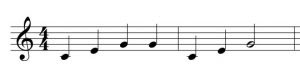
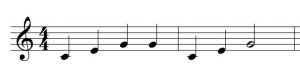
In a four/4 time signature, there are iv beats per measure and the quarter notation receives one crush. A whole note takes upwards ane entire measure in 4/4 time. There are 8, eighth notes in four/four time. Most of the songs with basic piano chords that you tin can learn with Skoove will be in a 4/four.
"C" time signature
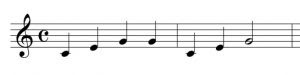
In fact, a 4/4 time signature is so common that it is often abbreviated at the beginning of a piece of music to a big C. This C stands for mutual time:
2/2 time signature
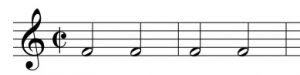
2/2, also known as "cutting time" is also very mutual and it's literally iv/iv cut in one-half. Each measure consists of two half notes. Information technology sounds nigh the same as 4/4 except it has a stronger accent on the third beat of each mensurate (the 2nd one-half note).
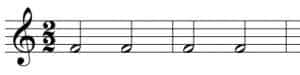
Cut time also has an abbreviation that looks like the common time symbol, but with a vertical line cut through it:
ii/4 time signature
two/4 is likewise a very common oftentimes used for marches:
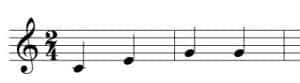
In a 2/four time signature, there are two beats per bar and a quarter note receives ane count.
3/4 time signature
3/4 is the near used after 4/4 and 2/4. With 3 beats per measure, information technology creates a lilting waltz fourth dimension that was fabricated hugely popular in Vienna by the dandy Johann Strauss Two during the 19th century.
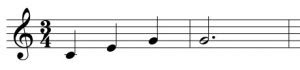
"Valse d'Amelie" is a beautiful waltz with a sad feel to it. Learn it right now on Skoove
3/eight is very like 3/4 except it's written with three eighth notes per measure instead of 3 quarter notes each measure. Fur Elise by Ludwig van Beethoven is written in 3/8.
Acquire to play "Fur Elise" – the beautiful and timeless masterpiece with Skoove.
Irregular time signatures – 5/four, 7/iv & 7/eight
Irregular or odd time signatures are the ones that can non be evenly divided into groups of 2 or 3 similar time signatures with 2, 3, 4, or 6 equally the elevation number.
5/iv time signature
5/4 is the well-nigh used "irregular". 5/four tin be very attention-grabbing because information technology doesn't fit neatly into an easy to understand rhythm as it feels "off-kilter".
It's ordinarily counted in a group of iii quarter notes followed by a group of two, but sometimes you'll find information technology counted in the reverse: ii and then 3.
Here are two measures in 5/four time. In the first one, you can see there are 5 quarter beats, then the notes are evenly spaced. Notwithstanding, in the second mensurate the beginning 2 quarter beats are cleaved into four 8th notes and the second and 3rd are tied.
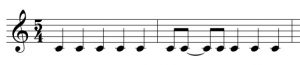
This second measure out is a very common rhythm used in 5/4 and you'll hear it in the jazz song "Take Five".
Written by composer Paul Desmond, the song was made famous past pianist Dave Brubeck when his jazz band's single became a surprise striking in 1961.
Only 5/4 was used long before this. Gustav Holst used five/iv to create the opening of his masterpiece, "The Planets", written between 1914-16. He created dramatically cinematic music in "Mars – the bringer of war" which became the "sound" associated with space when it was eventually depicted in movies years later. Information technology's still played a lot in concerts and used in many Tv set shows and documentaries. See if you lot can count five beats per measure while you're listening.
Another very famous slice of music in 5/4 is the theme from the Tv set and film series Mission Incommunicable (written by Lalo Schifrin). In this great live rendition the conductor talks about how to count the fourth dimension in a very entertaining way.
vii/four and seven/8 time signatures
7/4 and seven/8 are used quite a lot and tin can be counted in different ways. Most oft, they are counted with a group of 4 beats followed past a grouping of iii beats.
Yous could get the aforementioned event past writing a measure of 4/four followed past a measure of iii/4, but it is easier for a musician reading the music notation if the time signature changes as petty as possible. 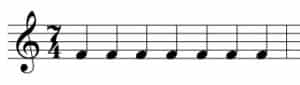
Have a listen to Broken Social Scene's song "vii/4 (Shoreline)". More famously, Pink Floyd'due south "Coin" is in 7/iv.
Chemical compound fourth dimension signatures
All the time signatures we've looked at then far are chosen "elementary" considering each it can be divided into two equal sections.
Merely at that place is another type called "chemical compound". Chemical compound are divided into groups of 3. They consist of eighth notes grouped in threes – (so the bottom number will be an eight).
6/8 time signature
The most common compound time is 6/8. In 6/8 time, there are vi eighth notes in a measure out and the eighth note receives one count. Generally, 6/8 time is divided into two groups of 3 8th notes. Here is the opening of the " Game of Thrones " theme tune in vi/eight fourth dimension:

9/8 time signature
nine/eight is made up of 3 groups of three 8th notes. There are nine beats in a measure out and an 8th note receives one beat. Hither is the famous opening of Bach's "Chorale" from Cantata No 147:

Dave Brubeck's Blue Ronda A la Turk is an unusual have on the 9/8.
12/8 time signature
12/8 is made up of four groups of three 8th notes.
It's worth mentioning that a slice in a compound time could too be written in a simple time using triplets to form the groups of three.
Beethoven wrote the opening of the Moonlight Sonata (op. 27 No ii in C# minor) in cut time using triplets throughout:
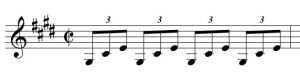
If we rewrite these measures in 12/8, it will sound exactly the same:
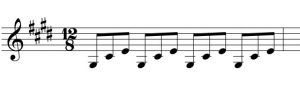
Yous can learn to play this right at present with Skoove:
Another great song that's in 12/8 is "Perfect" past Ed Sheeran.
three/viii fourth dimension signature
3/8 is very similar to iii/4 except that it is written with three eighth notes per measure out instead of 3 quarter notes each measure.
Fur Elise by Ludwig van Beethoven is written in 3/viii. Learn to play "Fur Elise" – the beautiful and timeless masterpiece with Skoove.
Although information technology's the same as iii/4 in essence, you might assume that the piece volition exist played a bit faster in iii/8. Just e'er exist guided by any instructions at the beginning of the pianoforte sheet music , such as "Moderato" (pregnant moderate speed) or "Presto" (meaning fast).
Odd fourth dimension signatures
A composer tin brand a option when information technology comes to fourth dimension signatures – equally you lot tin can run into, there is more than one way to write a piece of music to convey the sound you want.
There are pieces of music written in much more adventurous time signatures. For example, the gaming music "The Legend of Zelda: Ocarina of Time – Ganandorf's Battle Theme" was written in a 23/sixteen. This means at that place are 23 beats per measure out and the sixteenth note receives 1 vanquish!
A composer tin create whatever time signature they need. However, the person who is going to be reading and interpreting the music notation should exist considered and clarity should be the aim.
"Praeludium fifteen in Yard major" by J. S. Bach is written with a dissimilar time signature for each hand. Namely, 24/xvi for the right hand and mutual fourth dimension for the left.
Changing time signatures
A piece of music doesn't have to stay in the aforementioned time signature the whole fourth dimension, it can movement every bit freely as the composer wishes from one to another as many times as they desire. Many songs and classical pieces practise this.
A peachy instance of a piece of music that changes time signatures a lot is "Short Ride in a Fast Machine" by John Adams. If y'all've never read an orchestral score before, y'all may find this very interesting. Y'all only read across each page one time every bit everything on the page is happening at the aforementioned time.
Notice that the first i is iii/2. This means there are iii beats per measure out and the one-half notation receives one shell.
It changes often in this piece. Inside each time signature, mind out for more complex rhythms within the measures that brand it sound like the time signature has inverse again, when information technology hasn't.
If y'all feel similar you've been on a roller coaster past the end, the composer has achieved his goal!
Writer of this web log postal service:

Eddie Bond is a multi-instrumentalist performer, composer, and music instructor currently based in Seattle, Washington U.s.a.. He has performed extensively in the US, Canada, Argentina, and China, released over forty albums, and has over a decade experience working with music students of all ages and ability levels.
How to Read Time Signatures on Sheet Music
Source: https://www.skoove.com/blog/time-signatures-explained/
0 Response to "How to Read Time Signatures on Sheet Music"
Post a Comment